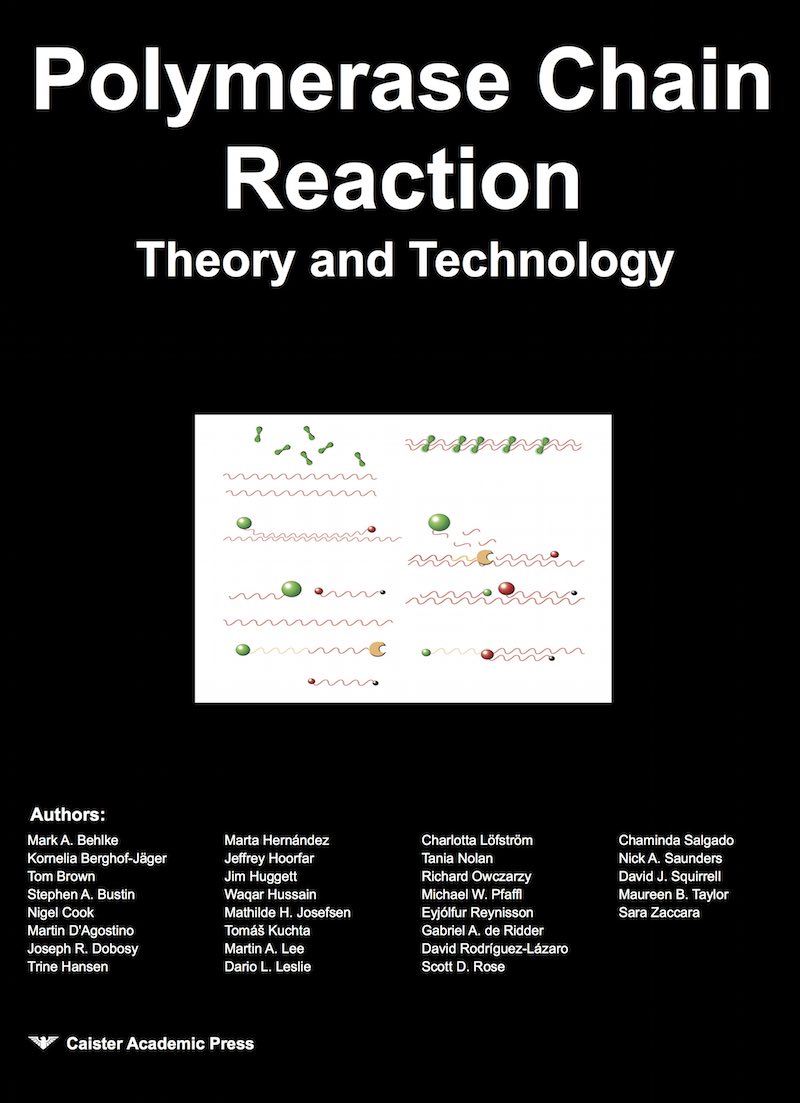
real-time PCR
RT-PCR book review
"This volume should be of utmost interest to all investigators interested and involved in using
RT-PCR ... the RT-PCR protocols covered in this book will be of interest to most, if not all, investigators engaged in research that uses this important technique ... a well balanced book covering the many potential uses of real-time PCR ... valuable for all those interested in RT-PCR." ...
read morefrom Doodys reviews
2009 Further reading:
Real-Time PCR: Current Technology and ApplicationsLabels: book review, real-time PCR, RT-PCR
Now available on the web: A comparison of the following
PCR machines lists various features to help you decide which qPCR instrument is most suitable for your needs.
- Applied Biosystems: ABI 7300, ABI 7500, ABI 7500 Fast, ABI 7900 Fast HT with automation accessory, ABI StepOne
- Roche: LightCycler 480, LightCycler 1.5, LightCycler 2.0
- Stratagene: Mx4000, Mx3000P, Mx3005P
- Cepheid: SmartCycler
- Corbett: Rotor-Gene 6000
- Eppendorf: Mastercycler ep realplex
- BioRad: MiniOpticon, MyiQ, Opticon2, Chromo4, iQ5
read more ...Bibliography:
- Real-Time PCR: Current Technology and Applications
- Real-Time PCR in Microbiology: From Diagnosis to Characterization
- PCR Troubleshooting: The Essential Guide
- PCR Books
Labels: instruments, molecular machines, platforms, qPCR, real-time PCR
PCR Troubleshooting: KCl Concentration
Potassium chloride (KCl) is normally used in a PCR amplification at a final concentration of 50mM. To improve the PCR amplification of DNA fragments, especially fragments in the size range 100bp to 1000bp, a KCl concentration of between 70mM and 100mM is sometimes recommended. For the amplification of longer products a lower salt concentration appears to be better. But the PCR amplification of short products works better at higher salt concentrations. This is probably because an increase in salt concentration permits shorter DNA molecules to denature preferentially to longer DNA molecules. Shorter molecules are therefore amplified better at higher salt concentration. It should be remembered however that a salt concentration above 50mM can inhibit the Taq polymerase.
If you are finding unwanted, long, non-specific products an increase in KCl concentration may reduce the appearance of these products. Similarly, to get rid of short, non-specific products you can decrease the KCl concentration to about 35 or 40mM. In either case do not change the MgCl
2 concentration. To improve the yield of a product you can try adjusting the KCl concentration: increase it for a desired product less than 1000bp; lower it for a desired product greater than 1000bp.
Further reading:
- PCR Books
- Real-Time PCR: Current Technology and Applications
- Real-Time PCR in Microbiology: From Diagnosis to Characterization
- PCR Troubleshooting: The Essential Guide
Labels: PCR, PCR troubleshooting, real-time PCR
PCR Troubleshooting: Mg Concentration
Magnesium is a required cofactor for thermostable DNA polymerases. Mg
2+ in the PCR mixture stabilizes dsDNA and raises the Tm. Mg
2+ concentration therefore is an important for controlling the specificity of the reaction. A low Mg
2+ concentration requires more stringent base pairing in the annealing step. Too few Mg
2+ ions result in a low yield of PCR product; too many Mg
2+ ions increase the yield of non-specific products and promote misincorporation.
Insufficient Mg
2+ concentration in a PCR mixture can causes failure of the reaction. Excess magnesium (or the presence of manganese) will cause the fidelity of DNA polymerases to be reduced and may cause the generation of unwanted products. On a gel this can appear as a ladder or smear. The MgCl
2 concentration should normally be between 1mM and 4mM. Since dNTPs sequester Mg
2+ ions, a major change in the dNTP concentration in a rection would require a change in the concentration of MgCl
2. Similarly, changing the KCl-based buffer concentration or any other component of the PCR mix may require adjustment of the Mg
2+ concentration in the reaction mixture.
Further reading:
- PCR Books
- Real-Time PCR: Current Technology and Applications
- Real-Time PCR in Microbiology: From Diagnosis to Characterization
- PCR Troubleshooting: The Essential Guide
Labels: PCR, PCR troubleshooting, real-time PCR
PCR Troubleshooting: Taq Concentration
In a
PCR experiment approximately 1 unit of the Taq enzyme should be used for a 25μl reaction. Suboptimal concentration of the Taq enzyme can cause incomplete primer elongation or premature termination of the PCR product synthesis during the elongation step of a PCR cycle.
Too much Taq will result in an excessive background of unwanted DNA fragments (a smear on a gel) while a huge excess may cause the reaction to fail with no product being detected. A Taq concentration of 1 unit per 25μl reaction ensures a cleaner product and lower background.
Further reading:
- PCR Books
- Real-Time PCR: Current Technology and Applications
- Real-Time PCR in Microbiology: From Diagnosis to Characterization
- PCR Troubleshooting: The Essential Guide
Labels: PCR, PCR troubleshooting, real-time PCR, Taq
PCR Troubleshooting: Primer Concentration
The recommended primer concentration for
PCR is between 0.1μM and 1μM of each primer. The use of higher concentrations of primers can have the following effects:
- If the primers are capable of forming dimers, raising their concentration only results in the creation of primer-dimers and does not improve the amplification of the desired PCR product. Primer-derived oligomers will possibly contaminate the reaction.
- If the primers do not form primer-dimers, it is likely that raising the primer concentration will lead to non-specific primer binding and the creation of spurious, undesirable PCR products.
Raising the primer concentration does not therefore cause an increase in the effective concentration of the primers. Low primer concentration generally ensures cleaner product and lower background.
However, to amplify short PCR target sequences, careful calculation of the optimum primer concentration is required. For example, if the target fragment length is 100bp, a greater number of PCR product molecules is required to provide a specified amount of amplified DNA (in nanograms) than for a larger target fragment. In order to generate the required number of PCR product molecules, a greater number of primers may be needed. Therefore, concentration of primers higher than 1μM may be necessary, and desirable, for short target sequences.
Further reading:
- PCR Books
- Real-Time PCR: Current Technology and Applications
- Real-Time PCR in Microbiology: From Diagnosis to Characterization
- PCR Troubleshooting: The Essential Guide
Labels: PCR, PCR troubleshooting, real-time PCR
An incorrect concentration of deoxynucleotidetriphosphates (dNTPs) can cause problems for the PCR procedure. The usual dNTP concentration is between 40μM and 200μM of EACH of the four dNTPs. Excessive dNTP concentrations can inhibit the PCR preventing the formation of product. However, concentrations up to 400 μM each dNTP have been reported to work adequately. Low primer, target, Taq, and dNTP concentrations are preferable as these generally ensure cleaner product and lower background. For longer PCR-fragments a higher deoxynucleotidetriphosphate concentration may be required. A large change in the dNTP concentration may require a corresponding change in the concentration of MgCl
2.
Suboptimal concentration of nucleotides can cause incomplete primer elongation or premature termination of DNA synthesis during the elongation step of the PCR cycle.
from PCR Troubleshooting: The Essential Guide Further reading:
PCR BooksReal-Time PCR: Current Technology and ApplicationsLabels: PCR, PCR troubleshooting, real-time PCR
The DNA in a PCR reaction comprises two types:
- the target sequence to be amplified
- the non-target DNA (also called the "burden" DNA
The amount of total DNA in a PCR has a marked effect on the outcome of a PCR procedure. Using too much total DNA results in packed DNA in the confined space of the reaction vessel and can lead to false priming and even poor DNA synthesis due to the obstructed diffusion of large
Taq polymerase molecules. However the ratio of target DNA to burden DNA is also important. The concentration of the target DNA should be balanced with the number of cycles in the reaction. Using an elevated concentration of the target combined with the normal, or higher than normal, number of cycles can cause the accelerated accumulation of nonspecific products. The accumulation of nonspecific products is often observed in a reamplification PCR, when the high initial concentration of the PCR fragment is accompanied by a high number of cycles. Reducing the number of cycles may help. However, low concentrations of primer, target, Taq, and nucleotides are recommended as these generally ensure cleaner product and lower background.
Problems also occur when the ratio of the target DNA to the burden DNA is very low, for example the amplification of a 500 bp fragment from the human genome (1 to 6 x 10
6). A better ratio is between 1:1 and 1:1 x 10
4. A ratio of 1:1 is achieved in a reamplification reaction and a ratio of about 10
4 is achieved when amplifying from the
Escherichia coli genome.
When the total amount of the DNA in a PCR reaction is extremely small, there is an increased likelihood of its loss owing to any conceivable cause (clotting, adsorption, chemical or enzymatic degradation). Furthermore, a small amount of target DNA leads to an increased risk from contaminating DNA from impurities on anything that can come into contact with the DNA solution. In this respect, both the DNA diluent, the dust floating in the air, exhalations and even particles of skin or hair from your body should not be disregarded, as these can carry both the DNA and the DNA-degrading substances. Nucleases are probably as the major cause of DNA degradation in a PCR procedure. They are abundant on the surface of the human skin and can be present everywhere else too. Mild autoclaving of the DNA diluent and everything that comes in regular, occasional, or accidental contact with buffers and solutions will destroy both the nucleases and comtaminating DNA. If you suspect problems of this nature, wear gloves, a surgeon's cap, and a face mask. Also, wash the working space with an oxidizing substance such as (6% H
20
2).
from PCR Troubleshooting: The Essential Guide Further reading:
PCR BooksReal-Time PCR: Current Technology and ApplicationsLabels: PCR, PCR troubleshooting, real-time PCR
NASBA is an isothermal
nucleic acid amplification method which is particularly suited to detection and quantification of genomic, ribosomal or messenger RNA. The product of NASBA is single-stranded RNA of opposite sense to the original target. The initial NASBA methods relied on liquid or gel-based probe-hybridisation for post-amplification detection of products. More recently, real-time procedures incorporating amplification and detection in a single step have been applied to a wide range of RNA and some DNA targets. Real-time NASBA has become a sensitive and specific method for detection, quantification and differentiation of RNA and DNA targets. Molecular beacons have been used in real-time NASBA in commercially-available kits in published assays. The increase in availability of fluorimeters suitable for real-time NASBA ensures that this methodology will become a realistic alternative to real-time reverse transcriptase PCR.
NASBA technology is an alternative method to standard proceduresfor the amplification and detection of a range of nucleic acid targets. The majority of applications have been developed for detection and analysis of RNA targets including viral genomes, viroids, ribosomal RNA (rRNA) and messenger RNA (mRNA). Advantages of NASBA over methods such as reverse transcriptase PCR include fast amplification kinetics and selective amplification of RNA in a background of DNA. The amplification is isothermal and thus there is no requirement for thermocycling during the procedure. Single-stranded RNA amplicons are produced by NASBA which can be used directly in subsequent rounds of amplification or probed for detection without the need for denaturation or strand separation.
Real-time NASBA assays are rapid, specific and sensitive with RNA amplification and a target-specific fluorescent signal achieved simultaneously in one tube with measurements obtained through a fluorimeter. Qualitative, quantitative, monoplex and multiplex formats of real-time NASBA have now been described. The methodology seems to be a suitable alternative to other amplification procedures without the need for expensive thermocyclers. Since the original reports of real-time NASBA in 1998 the number of applications, available kits and expansion to include DNA targets is apparent and likely to continue over the next few years.
from Fox et al
in "Chapter 12: Real-Time NASBA" from
Real-Time PCR: Current Technology and ApplicationsFurther reading:
Real-Time PCR: Current Technology and ApplicationsLabels: DNA, NASBA, real-time PCR, RNA, RT-PCR
Molecular Tools for Pathogen Detection in Plants
Plant pathogenic bacteria, phytoplasmas, viruses and viroids cause harmful, widespread and economically important diseases in a very broad range of plant species worldwide. Damage is often sufficient to cause significant yield losses in cultivated plants. The two main effects on agriculture are decreased production and, in a less direct way, the need for the implementation of expensive management and control procedures and strategies.
The lack of suitable chemical control methods means that prevention is necessary to avoid the dissemination of the pathogens. Prevention measures require pathogen detection methods of high sensitivity, specificity and reliability, because many
phytopathogenic bacteria and viruses can remain latent, in low numbers, or in special physiological states in propagative plant material and in other reservoirs. Accurate detection of phytopathogenic organisms is crucial for virtually all aspects of plant pathology, from basic research on the biology of pathogens to the control of the diseases they cause.
Rapid and accurate methods for detection and diagnosis of plant pathogens are required to apply treatments, undertake agronomic measures or proceed with eradication practices, particularly for quarantine pathogens. In recent years, there has been an exponential increase in the number of protocols based on nucleic-acid tools. Those based on PCR or
Real-Time PCR are routinely used worldwide. However, nucleic acid extraction is still necessary in many cases and inhibition problems are decreasing the sensitivity of molecular detection. Integrated protocols that include the use of molecular techniques as screening methods, followed by confirmation by other techniques are advisable. Overall, molecular techniques based on different types of PCR amplification and especially on
real-time PCR are leading to high throughput, faster and more accurate detection methods for the most severe plant pathogens, with important benefits for agriculture.
from Lopez et al
in Curr. Issues Mol. Biol. (2009) 11: 13-46Further reading:
Plant Pathogenic Bacteria: Genomics and Molecular BiologyReal-Time PCR: Current Technology and ApplicationsReal-Time PCR in Microbiology: From Diagnosis to CharacterisationLabels: bacteria, pathogen, PCR, plant, real-time PCR
Real-time PCR has removed many of the limitations of standard end-point PCR and since its introduction in the mid-1990s there has been an explosion both in the number of publications and available instrumentation describing real-time PCR applications across many disciplines. Real-time PCR (
RT-PCR) technology is highly flexible and many alternative instruments and fluorescent probe systems have been developed recently. The decreased hands-on time, increased reliability and improved quantitative accuracy of RT-PCR methods have contributed to the adoption of RT-PCR for a wide range of new applications.
The development of instruments that allowed real-time monitoring of fluorescence within PCR reaction vessels was a significant advance. The technology is flexible and many alternative instruments and fluorescent probe systems are available. RT-PCR assays can be completed rapidly since no manipulations are required after the amplification. Identification of the amplification products by probe detection in real-time is highly accurate compared with the traditional PCR method of size analysis on gels. Analysis of the progress of the reaction allows accurate quantification of the target sequence over a very wide dynamic range, provided suitable standards are available. Further investigation of the RT-PCR products within the original reaction mixture using probes and melting analysis can detect sequence variants including single base mutations. RT-PCR has found applications in many branches of biological science. Applications include gene expression analysis, the diagnosis of infectious disease and human genetic testing. Due to their fluorimetry capabilities, these real-time machines are also compatible with alternative amplification methods such as NASBA, provided a fluorescence end-point is available.
The introduction of
RT-PCR assays to the clinical microbiology laboratory has led to significant improvements in the diagnosis of infectious disease. The technology has applications in clinical bacteriology, parasitology and virology. There are few areas of clinical microbiology which remain unaffected by this new method. It has been particularly useful to detect slow growing or difficult to grow infectious agents.Its greatest impact is probably its use for the quantitation of target organisms in samples. The ability to monitor the PCR reaction in real-time allows accurate quantitation of target sequence over at least six orders of magnitude. The closed-tube format which removes the need for post-amplification manipulation of the PCR products also reduces the likelihood of amplicon carryover to subsequent reactions reducing the risk of false-positives. Standardisation of assay protocols for use in diagnostic clinical microbiology and external quality control schemes is required to ensure quality of testing.
Further reading:
Real-Time PCR: Current Technology and ApplicationsReal-Time PCR in Microbiology: From Diagnosis to CharacterizationLabels: diagnostics, PCR, qPCR, real-time PCR, RT-PCR